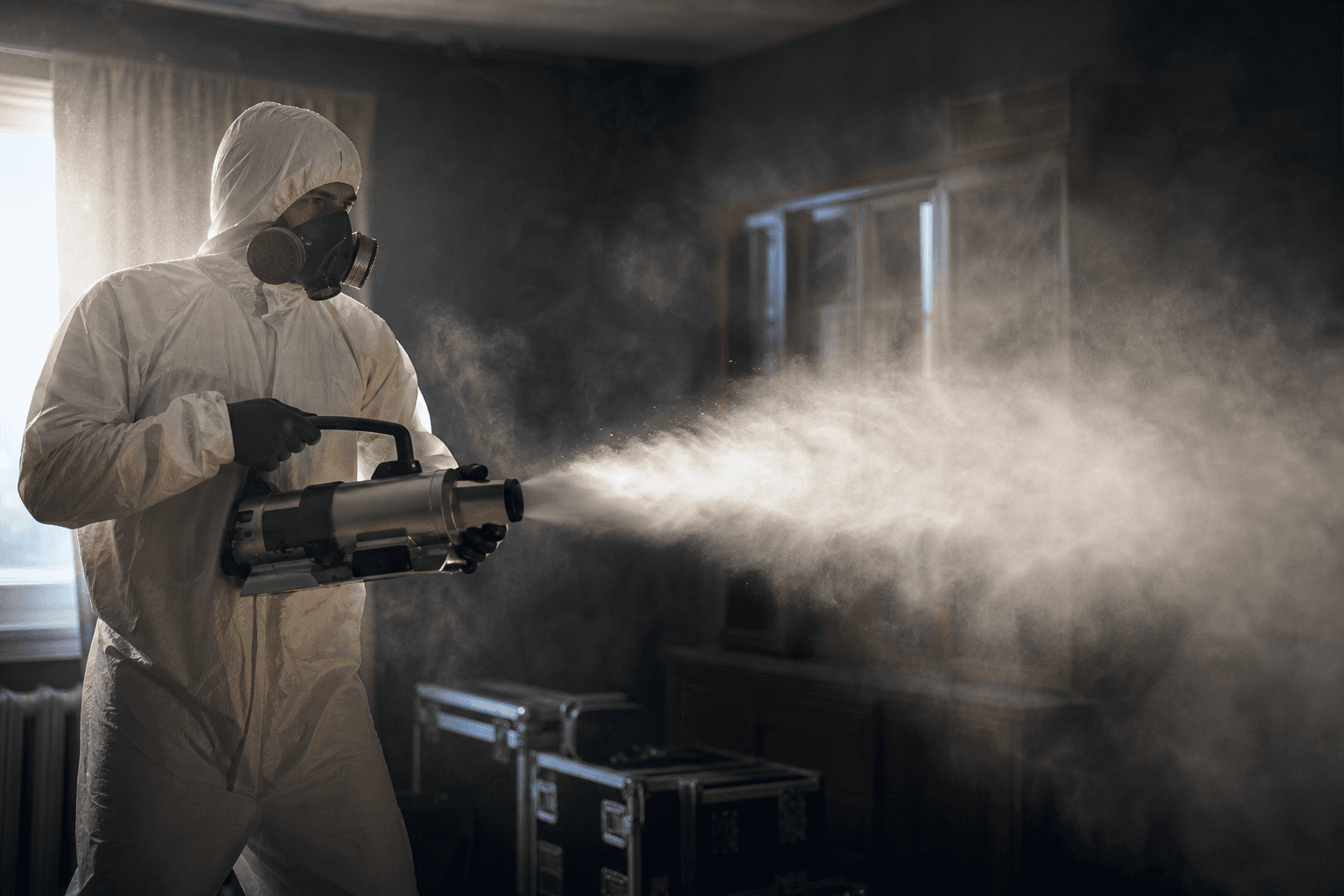
Fogging & Antimicrobial Treatment in Dartmouth, NS
For spores you can't see. Fogging reaches the airborne and hidden growth that wiping a wall misses.
Fogging applies an antimicrobial treatment as a fine mist that reaches airborne spores and hidden growth that wiping surfaces can't. It's used after mold removal to treat the spores you can't see, throughout Dartmouth and the Halifax area.
When mold is visible, there's usually more you can't see, spores in the air and in spots a cloth never reaches. Fogging fills the space with a fine antimicrobial mist that settles into those areas and treats them.
We use it as a finishing step after removing the mold itself, not as a shortcut instead of removal. Fogging a room without dealing with the source and the visible growth is just spraying perfume on the problem. Used the right way, it's a strong final step.
When fogging helps
- After mold removal, to treat lingering airborne spores
- In hard-to-reach spaces like attics and crawl spaces
- Across larger areas where surface wiping isn't practical
- As part of odour control alongside deodorizing
Serving Dartmouth and the whole Halifax area
Dartmouth Water Damage Pros is based in Dartmouth and covers the surrounding communities. See all areas we serve →
Fogging & Antimicrobial Treatment: common questions
Is antimicrobial fogging safe for my family and pets?
The products we use for fogging are safe once the treated area has been properly ventilated after application. People and pets should stay out during the treatment and for the period specified on the product label, usually a few hours. We'll tell you exactly when it's safe to come back in. The fogging agents we use are chosen for effectiveness against mold spores while being appropriate for residential use.
Does fogging replace mold removal and remediation?
No. Fogging is a finishing step, not a substitute for removal. If visible mold is present, it needs to come out first. Fogging over mold without removing it is like painting over rust. The antimicrobial mist is effective at treating airborne spores and surface residue after the physical mold has been removed, but it doesn't break down or eliminate bulk mold growth. We always remove first, then fog.
How long does an antimicrobial fogging treatment last?
Fogging treats the spores present at the time of treatment. How long the effect holds depends on whether the moisture source has been addressed. If the cause of the mold is fixed, the fogged space should stay clean. If moisture is still present, mold can reestablish over time. Fogging is most effective as the final step of a complete remediation, not as a standalone maintenance spray.
Can fogging be used in attics and crawl spaces?
Yes, and it works especially well in those spaces. Attics and crawl spaces have corners, joists, and tight areas that are hard to physically wipe or treat. After removing visible mold growth, we fog the full space to treat residual spores throughout. It's a standard part of our attic mold removal process for Dartmouth and Halifax-area homes.
How is fogging different from ozone treatment for mold and odour?
Fogging applies an antimicrobial liquid as a fine mist to kill or neutralize mold spores on surfaces and in the air. Ozone treatment uses ozone gas to oxidize and break down odour molecules and some biological contaminants. They work differently and serve different purposes. Ozone is primarily for odour and requires the space to be completely vacated for a longer period. Fogging is targeted at mold spores. We choose the right tool based on what the job actually needs.
Is fogging used during or after mold remediation?
After. We complete the physical removal of mold-damaged materials first, then run HEPA air scrubbers to clean the air, and then fog as the final treatment step. Fogging during removal doesn't make sense because the disruption of materials keeps releasing new spores. Doing it at the end, when the space is clean and contained, gives the treatment the best chance to work.
Got water damage or mold? Let's sort it out.
Call and tell us what's going on, or send a message and we'll get right back to you. Dartmouth's local restoration company covering the whole Halifax area.